Archives - Page 2
Nº 27. El aprendizaje basado en problemas en sus textos. Ejemplos de su empleo en biomedicina
L’aprenentatge basat en problemes (ABP) té com a principal objectiu que els estudiants puguin obtenir el coneixement per sí mateixos. Per tal de fer-ho, els hi cal la reflexió crítica, la indagació, el debat, la recerca d’informació i la conclusió. En aquest procés aconsegueixen les facultats que els seran útils pel seu futur i, al mateix temps, aprenen a plantejar i respondre les preguntes pertinents per resoldre una situació, plantejada com un problema.
Encara recent el debat a la universitat espanyola sobre el procés d’adaptació a l’Espai Europeu d’Educació Superior, el Quadern de la Fundació Dr. Antoni Esteve El aprendizaje basado en problemas en sus textos neix com a instrument per facilitar la incorporació de l’ABP a les institucions educatives. Per això, 29 experts docents presenten les bases d’aquesta metodologia d’aprenentatge i múltiples exemples de textos reals per posar en pràctica el coneixement.
Els coordinadors d’aquesta nova publicació acumulen una gran experiència a l’hora de preparar textos, dirigir grups de tutoria, coordinar cursos i formar altres professors en la lògica de l’ABP. Ells són Luis A. Branda, de la Unitat d’Educació Mèdica de la Universitat de Girona, i Mar Carrió i Josep-Eladi Baños, del Departament de Ciències Experimentals i de la Salut de la Universitat Pompeu Fabra, departament amb un èxit reconegut en la implementació de l’ABP.
El llibre es dirigeix a tots aquells que aspiren a desenvolupar una carrera docent en biomedicina i també a tots aquells que ja es troben immersos en ella, just en el moment precís en què l’educació mèdica canvia de paradigma, cap a un model en què les necessitats d’aprenentatge de l’estudiant guiïn l’activitat docent.
Com afirma Albert Oriol Bosch, president de la Fundació Educació Mèdica, en el pròleg del llibre, “l’ABP constitueix un enfocament docent indefugible per a les institucions educatives socialment responsables. Els canvis en la cultura institucional que precisen les nostres facultats difícilment es podran donar si els seus equips humans no disposen de les oportunitats per desenvolupar-se com a educadors. Aquesta obra és un gran instrument per facilitar-ho”.

Nº 26. Bioestadística para periodistas y comunicadores
If interpreting a statistic or research is often difficult for health professionals, the task can become be even more difficult for journalists reporting on science. In the field of health there is little certainty, everything is a possibility, and one of the basic functions of the reporter is to clearly explain this uncertainty.
Precisely because biostatistics is one of the major shortcomings of journalists and science communicators, the Spanish Association of Science Communication and the Esteve Foundation decided to organize a workshop at the National Cardiovascular Research Centre to shed some light on some basic concepts and to discuss the problems encountered by biomedical journalists when trying to make sense of statistical data.
This new Esteve Foundation Notebook is a compilation of the presentations and dialogues between journalists and statisticians that took place during the workshop, and it offers numerous indications and guidelines to improve the reporting of results in medical research. The workshop coordinator, Gonzalo Casino, who has over a decade of experience in reporting on health affairs in Spain, outlines in the first chapter of the book some of the most common mistakes made by his profession, such as ignoring absolute risk, over exaggerating prevention or giving too much attention to animal studies.
But the Notebook not only reflects the views of science journalists. Erik Cobo, from the Department of Statistics and Operations Research at the Polytechnic University of Catalonia, offers some basic tips on interpreting empirical studies, while Jose Luis Peñalvo, researcher at the CNIC, focuses on the peculiarities of epidemiological studies. Meanwhile, Pablo Alonso, a researcher at the Cochrane Collaboration, explores systematic reviews, which are the studies that generate more trust and confidence in the scientific community.
Two international experts, Lisa M. Schwartz and Steven Woloshin, from the Geisel School of Medicine, who have led major research into communication of biomedical research, also participated in Biostatistics for journalists and communicators.
In addition to chapters covering the biostatistics talks given during the workshop, edited by Ainhoa Iriberri (Muy Intersante, BMJ), Esperanza Garcia Molina (SINC Agency) and Paul Francescutti (Advanced Communications Studies Group, Rey Juan Carlos University), the notebook is complemented by a special series of illustrations by the artist Enrique Ventura, for a playful and sceptical counterpoint to the interpretation of statistics in biomedicine.
To conclude the book, the authors offer a list of 33 key messages that science journalists should keep in mind when dealing with information from scientific studies.

Nº 25. El periodismo biomédico en la era 2.0
Approximately 4,000 layoffs and 70 closures of media organizations in 2012 alone. This is the bleak picture that currently faces journalists, according to the Federation of Journalists in Spain. These cutbacks in the media have also particularly affected biomedical journalists, a group that has traditionally been on the margins, who in recent years have witnessed a paradigm shift triggered by the explosion of the Internet.In the new Esteve Foundation Notebook El periodismo biomédico en la era 2.0, edited in collaboration with the Pompeu Fabra University’s Observatory of Scientific Communication (OCC), ten information experts reflect on the challenges facing the biomedical journalist in this era of the Internet, probably one of the most significant changes faced by journalists in the entire history of their profession.
This publication stems from the international symposium held in Barcelona in September 2011, which brought together more than 70 scientific communications professionals. Moderated by Vladimir de Semir, director of the OCC, the first block of the day addressed the challenges posed by the Internet for biomedical journalists, something that Connie St Louis, from BBC Radio 4, examines closely as Director of the Masters in Biomedical Journalism at City University, London. In an age dominated by the communication of information, the journalist must resurrect their role of investigating and questioning that which surrounds them.
For Ana Macpherson, from the science section of La Vanguardianewspaper and another contributing author to this Notebook, the current pressure for immediacy plays against rigor, while job insecurity conflicts with the specialization required of biomedical journalism. This is something about which Patricia Fernández de Lis is well versed, as she was once head of the science section of the now discontinued Público newspaper and today she is director of Esmateria.com. Her vision of the profession is inevitably pessimistic in an age that has to survive with a dearth of quality media, where impact is what is most important and where the journalist’s job is limited to separating the wheat from the chaff.
Is all the health information that is published newsworthy? This is another of the issues addressed by the Notebook in a second section of articles. Gary Schwitzer, director of online review Health News Reviews, notes that 70% of the information published offers an unbalanced view, exaggerating benefits and minimizing the risks.
His colleague Holger Wormer, who heads the German edition of Health News Review Mediendoktor.de, analyses the value of a news item those qualities that make a fact likely to be published. For his part, Pablo Francescutti, director of Group for Advanced Studies in Communications at Rey Juan Carlos University in Madrid, was able to quantify the selection criteria of media outlets in his study of scientific information in Spanish television news.
But if there is a situation that encapsulates all the opposing values in news publication and represents a magnet for the media, this is certainly a health crisis. Paz Gómez, from the newspaper La Verdad in Murcia, shows that a pandemic like the flu recently met ten of the fourteen most important criteria for newsworthiness. For her, the journalist must confront a health crisis with foresight, a communication strategy and aiming to avoid alarmism.
The Notebook contains a closing chapter by Milagros Pérez Oliva, from El País newpaper, who welcomes the Internet and sees it as a tool that provides new solutions to the problems that journalism has been confronting since its beginnings, such as the verification of sources or the diffuse border between communication and information.

Nº 24. Competing interests in biomedical publications: Main guidelines and selected articles
Coordinators: Ana Marusic and Harvey Marcovitch.
Each year brings to light several cases of scientific fraud. In 2011, the Netherlands Academy of Sciences struck off a renowned social psychologist who had falsified the results in several of his articles published in respected journals such as Science. He was one of the most notorious cases, on the heels of another scandal two years earlier when a respected U.S. scientist in multimodal analgesia apparently manipulated data in at least 20 articles published since 1996.
These are extreme cases, and the harm caused to patients and public health, they say, is limited. However, there are other types of misconduct in the field of scientific research that are more widespread, subtle and difficult to detect. These include practices such as selective publication of data to support a previous hypothesis, biased discussion, the hiring of ghostwriters, plagiarism or the temptation of some journal editors to promote the articles with positive results.
These are just some examples of bad practice in the biomedical publishing world that organizations like the CSE (Council of Science Editors) and COPE (Committee on Publication Ethics) are responsible for reporting. Ana Marušić, a former president of CSE, and COPE President Harvey Marcovitch, have edited a new Esteve Foundation Notebook containing a selection of guides and articles on conflict of interest in biomedical journals.
The publication is intended as a useful tool for readers, authors and editors of scientific journals, and for those who are interested to preserving the integrity of scientific knowledge. A collection of a wide range of resources for combating bad practices in biomedical publication, the book addresses conflict of interest as a factor that may have a significant adverse effect on the field of research. And although findings of malpractice are less serious than the falsification or fabrication of data, cumulatively their damage on scientific knowledge can be greater than that of the most notorious cases.
*For copyright issues, it is not possible to download the full PDF of the Notebook or chapters 2, 12 or 15. – The updated version of Chapter 2 can be downloaded directly from theCSE website. – The PDF version of Chapter 12 can be requested via email from fundacion@esteve.org

Nº 23. Manual de traducción inglés-español de protocolos de ensayos clínicos
The protocol is the detailed written record of the method used in clinical trial and it has a decisive influence on the study’s quality and reliability of results. Even though it is a scientific document, it is aimed at a wide range of readers, from the most specialized to the most general. Translation should involve rigor, precision and clarity, but these become even more important in the translation of clinical trial protocols, since a mistake can have serious consequences and even threaten the lives of the people being studied.
Pablo Mugüerza, a specialist in medical translations, is the editor of this manual whose aim is to facilitate the task of the translator of clinical trial protocols. These are usually dry and dense texts that are full of jargon and concepts known only by a handful of experts, and which test the skills of the best translator. The translation of these protocols involves attention to the subtleties of expression and turns of language, especially treacherous in section that are apparently simple, e.g. the data collection instruments, consent solicitation or patient outcomes.
In a systematic, logical and precise way, the Booklet of English-Spanish translation of clinical trial protocols, published by the Esteve Foundation, guides the reader through the different parts of a protocol, indicating at each step the keys to translating and illustrating each recommendation with practical examples. The literature that supports the material is broad and the tools recommended are abundant and easily accessible via the Internet.
In this way, and as recommended by the editor Pablo Mugüerza, this 23rd Esteve Foundation Notebook can be used not only as a guide to translate clinical trial protocols, but also in many other ways. The final glossary serves as a specialized dictionary of equivalents. Its practical section also serves to check concrete terms. Finally, it can be used as a reference, to find out more about the opinions of the authors or simply as a book to read to learn more about clinical trial protocols in general.

Nº 22. Eponímia mèdica catalana II
An eponym (from the Greek, eponymos, meaning “appointed by” or “a because of”), according to Diccionario Enciclopédico de Medicina, is the name given to a disease, symptom, anatomical accident, intervention, etc., derived from the person who is credited with the discovery or description first.
Following the publication of the first volume in 2004, Josep-Eladi Bañosand Elena Guardiola, from the Department of Health and Experimental Sciences at Pompeu Fabra University, have returned to investigate some of the most important eponyms that have arisen in medicine in Catalonia and which the Annals of Medicine has published in the section Sense amnesia(No Amnesia).
The authors presented the book on May 24th 2011 during the awards of Academy of Health and Medical Sciences of Catalonia and Baleares, among whom was present the Minister of Health of the Catalan Government, Boi Ruiz, and the president of the Academy, Àlvar Net.
At the presentation Baños and Guardiola stressed the importance this Notebook on Catalan eponyms, which can be found in nearly all medical disciplines. Thus, for example, the Gimbernat ligament can still be found in books on anatomy, the Trueta method has helped save many lives and Barraquer techniques have helped millions of people. The last major example of a Catalan eponym is the Brugada syndrome.
This work is not only a collection of 29 medical eponyms of Catalan origin. It also further provides comprehensive information on what is described by each eponym (a surgical or anatomical structure, etc.) accompanied by biographical details of the person concerned. Finally, the authors note the publication that first contained a reference to the eponym.

Nº 21. La información científica en los telediarios españoles
Following the sequencing of the human genome, the SARS outbreak and therapeutic cloning, the debates on science journalism organized by the Esteve Foundation this time focused on an unpublished study on major Spanish television channels’ coverage of scientific news. This research was carried out by the Group for Advanced Study of Communication at theUniversidad Rey Juan Carlos, led by Professor Pablo Francescutti.
After analyzing all the news broadcast by the news on TVE1, Antena 3, Cuatro and Telecinco in their evening broadcasts from April 2007 to March 2008, the study determined for the first time that science occupies only 1.1% of all information disseminated. These figures mean that, on average and between all TV channels, a total of 30 science news items are broadcast a month or i.e. merely one each day.
Why does scientific content occupy such an inconsequential amount of airtime on Spanish news? What topics make it through the filter of the news? What are the most frequent sources of journalists? These are some of the questions raised by the report which formed part of the fourth debate on science journalism held by the Esteve Foundation on November 6, 2009, which took place in Madrid for the first time. Again, four journalists and four scientists were invited to exchange views and shared ideas about the research data collected by Francescutti. This Esteve Foundation Review brings together two valuable areas of analysis.
Firstly, the results of research on the reporting of scientific information on Spanish television news, which is the first time that the volume of scientific news over the course of a year in news broadcasts with the biggest audience has been studied. Secondly, the reflections of the eight participants in the debate on this data. The scientific field is represented in the book by José Elguero, of the Institute of Medical Chemistry of the Higher Council for Scientific Research (CSIC); Antonio Hernandez, director of the Institute of Applied Magnetism; Ignasi Ribas, researcher of Astrophysics at CSIC; and Antoni Trilla, from the Department of Preventive Medicine and Epidemiology at Barcelona Hospital Clinic.
The world of journalism is represented in the review by Graziella Almendral, former editor of Antena 3 News and currently working at Indagando TV, an internet channel devoted entirely to science; Antonio Calvo Roy, president of the Spanish Association of Scientific Communication; Ignacio Fernández Bayo, director of the scientific promotion company Divulga SL; and Jose Maria Montero, director of the environmental TV program Espacio Protegido on Canal Sur 2.

Nº 20. Presentaciones orales en biomedicina. Aspectos a tener en cuenta para mejorar la comunicación
In 2005, the Esteve Foundation launched a new Training seminar on how to make a good oral presentation in the field of biomedicine. This new booklet brings together for the first time in Spanish some general recommendations that should be considered in order to make a good oral communication in the scientific field.
The communication of results, either through a scientific article or an oral presentation, is one of the most important stages of any investigation; however, training in this area has been relegated to a kind of implicit learning in daily work. Indeed, a recent study published in Medicina Clínicalisted oral communication skills as one of the most sought after among health professionals.
The booklet brings together 20 purely scientific aspects regarding the content of a formal oral presentation, e.g. verbal expression, and the regulation of voice or body language. The recommendations address issues such as structuring the content, making scientific graphs and the main uses of PowerPoint, but also other essential issues such as diction, posture and bi-directionality with the audience.
To delve into all aspects that affect an oral presentation, the Notebook on oral presentations in biomedicine contains advice from both scientists (with extensive experience in professional communication) and from performing-arts professionals. Among the 11 chapters is an introduction on the importance of communication in science, by the Observatory on Scientific Communication at University Pompeu Fabra. This is accompanied by a separate chapter on the oral defense of a scientific poster, written by Elena Guardiola, from the university’s Department of Experimental Sciences and Health.

Nº 19. Dotze dones en la biomedicina del segle XX
Després de publicar la sèrie Dotze dones en la biomedicina del segle XX a Annals de Medicina, la revista de l’Acadèmia de Ciències Mèdiques i de la Salut de Catalunya i de Balears, la Fundació Dr. Antoni Esteve comença la distribució del quadern homònim que recopila les aportacions científiques i la biografia de dotze investigadores de primer nivell.
L’obra no només recull la recerca per la qual han estat reconegudes en la història de la medicina –set d’elles van obtenir un Premi Nobel- sinó també els obstacles que es van anar trobant al llarg de la seva carrera per tal d’obtenir un reconeixement professional.
Aquest és el cas, per exemple, de Rita Levi-Montalcini, Premi Nobel de Medicina pel descobriment del factor de creixement nerviós, i a qui el fet de ser dona, jueva i investigadora en plena dictadura de Mussolini no la va frenar per a dedicar tota la seva vida a la ciència.
Un reconeixement que no va obtenir de la mateixa forma Rosalind Franklin, científica que va tenir un paper decisiu en un dels avenços més transcendentals del segle XX –el descobriment de l’estructura del DNA- però que no va ser recompensada amb el Nobel concedit el 1962 a Watson, Crick i Wilkins.

Nº 18. Guía de plantas medicinales del Magreb. Establecimiento de una conexión intercultural
The phenomenon of immigration has presented a challenge for health professionals, not only regarding communication problems, but also in relation to the traditional customs for the treatment of diseases prevalent in the countries of origin. A large percentage of immigrants to Spain come from the Maghreb, where the use of medicinal plants in folk medicine is common practice.
In the consultation, patients do not usually mention the consumption of these alternative remedies, either because they are considered innocuous or because they are hesitant to do so. Doctors, meanwhile, often fail to ask from lack of habit and because until now there has not been a verifiable source that outlines the proven characteristics of these types of natural therapies.
For this reason, the Esteve Foundation has published a Guide to the medicinal plants of the Maghreb, a book that not only lists the main medicinal plants in the popular culture of the Maghreb and their active principles, but also identifies each of these plant drugs with their different names, their equivalents in standard Arabic and Berber and their common names translated into the four official languages of Spain. All this has been done so that doctors can accurately identify the traditional remedy and assess whether the patient should or stop or continue with the natural treatment while taking into account possible adverse effects.
The guide contains 25 colour images of the most common medicinal plants used in the Maghreb, each containing a description, side effects, contraindications and known interactions with conventional medications. Produced by José Alfonso del Villar Ruiz de la Torre and Esther Melo Herráiz, this volume is one of the few scientifically verified publications that presents a reasoned critique of these popular remedies.
Nº 17. La redacción médica como profesión. Qué es y qué hace el redactor de textos médicos
The figure of the medical writer is quite unknown. It is a thriving profession in sectors such as pharmaceuticals, in communications in the health area and in publishing; however, even within these areas the primary duties of the writer are unknown as are the types of documents that benefit from their highly specialized work. This publication by Esteve Foundation aims to aims to shed light on at least some of these issues by showing us who they are, what they do and how they work.
Fernando Rico-Villademoros and Vicente Alfaro, coordinators of this new publication, are members of the Association of Young Spanish Writers of Medical Texts, which aims to facilitate the exchange of information among these professionals. This organization aims to vindicate the role of a profession that in the United States has a trade association, the American Writers Association, with over 5,600 members and a 60-year history.
After outlining the evolution of medical writing in Spain, the first part of the book delves into the profession from its role in different areas: pharmaceutical companies, contract research organisations (CRO), health information agencies, and independent professionals or freelancers. The second half of the book covers aspects relevant to the practice of this profession as the continuing education or the access to sources of information.

Nº 16. El enfermo como sujeto activo en la terapéutica
El respecte a la llibertat de la persona i els drets del malalt han anat adquirint amb el temps un major pes en l'àmbit sanitari, on la implantació del consentiment informat ha suposat un dels avenços més rellevants. No obstant això, tots els esforços per dotar de majors garanties als pacients es troben amb una realitat diferent a la desitjable. En el millor dels casos, quan la persona coneix tots i cadascun dels seus drets, es topa amb la barrera infranquejable d'una terminologia mèdica difícil de desxifrar. Conceptes com dignitat o qualitat de vida es tornen tan irremediablement subjectius que resulta gairebé impossible delimitar-los.
Les decisions són més difícils com més greu és la situació del malalt i quan les emocions tenen més pes que les raons. I igualment són complicades quan sorgeixen esperances en forma d'assaig clínic i de medicaments prometedors. Alhora que augmenta la responsabilitat del pacient sobre la seva salut, creix també la necessitat de conèixer la seva percepció sobre algunes d'aquestes mesures que li garanteixen una major autonomia.
Amb aquesta filosofia, quatre professionals del món de la sanitat i quatre representants de diferents associacions de pacients van seure cara a cara per discutir diferents aspectes del tractament amb medicaments. Aquest nou Quadern de la Fundació Dr Antoni Esteve recull les reflexions dels vuit participants que es van donar cita a Barcelona el 2007 per participar en la jornada sobre El malalt com a subjecte actiu en la terapèutica.
La trobada es va centrar en quatre punts específics de la terapèutica en què el pacient té molt a dir. D'una banda, les virtuts, i també les limitacions, de l'eina legal per antonomàsia de l'autonomia del pacient: el consentiment informat. L'altra, el xoc, bastant freqüent, entre l'eficàcia terapèutica i la qualitat de vida. Seguidament, els dilemes que pot plantejar l'aparició de medicaments prometedors, encara que d'utilització necessàriament restringida. Finalment, la possibilitat de remunerar als pacients que accepten ser inclosos en un assaig clínic.
Representant a les associacions de pacients, van acudir a la cita Águeda Alonso, de l'Associació Espanyola d'Esclerosi Múltiple; Glòria Cavanna, de la Federació d'Associacions per la Defensa de la Sanitat Pública; Montserrat Domènech, del Grup Àgata (Associació Catalana de Dones Afectades de Càncer de Mama) i José Ramírez, de l'Associació de Pacients Coronaris APACOR.
La comunitat científica va estar representada per Xavier Carné, de la Unitat de Farmacologia Clínica de l'Hospital Clínic de Barcelona; María Casado, de l'Observatori de Bioètica i Dret de la Universitat de Barcelona; Pere Gascón, del Servei d'Oncologia Mèdica de l'Hospital Clínic de Barcelona i Gaietà Permanyer, del Servei de Cardiologia de l'Hospital Universitari Vall d'Hebron de Barcelona.
A més de les reflexions dels participants a la reunió, el Quadern també inclou la Carta de drets i deures dels ciutadans en relació amb la salut i l'atenció sanitària, elaborat pel Departament de Sanitat i Seguretat Social de la Generalitat de Catalunya. Si ho desitja, pot sol·licitar un exemplar del llibre a través de la web www.esteve.org.

Nº 15. Redacció científica en biomedicina: El que cal saber-ne
Publish or perish. This is the maxim whereby scientists are compelled to publish the results of their investigations if they are to achieve relevance in their professional environment. In fact, it is said that no research is over until it is written down on paper. However, despite the importance of publication in the career of any scientist, there is not one subject in standard curricula that introduces future researchers into the world of biomedical writing.
With already ten editions held throughout Spain, the training seminars onHow to write a scientific article prompted by the Esteve Foundation in 2001 were a first and tiny –but important– contribution. The present publication of ‘Scientific writing in biomedicine: what you should know’, an indispensable manual on scientific writing, again contributes to bridge this training gap.
In addition to a didactic development of the formal aspects to be considered when writing a scientific article, this book also gathers the different types of articles and the biomedical publishing process. This Notebook is basically directed to students and professionals of the scientific community.

Nº 14. Cómo elaborar folletos de salud destinados a los pacientes
Els fullets de salut són un dels mitjans més utilitzats per a l’educació sanitària de pacients, familiars, persones que vetllen malalts i ciutadans en general. Nombroses institucions de salut pública, empreses farmacèutiques, associacions de pacients i col•legis de metges, entre d’altres, s’esforcen en transmetre als ciutadans informacions de caràcter mèdic amb diferents propòsits. Tot i això, crida l’atenció l’escàs interès que encara avui susciten aquest tipus de textos entre la majoria de professionals sanitaris.
Aquest manual pràctic neix amb l’objectiu de servir com a guia per a l’elaboració de fullets de salut i per a millorar la seva qualitat en espanyol. Cómo elaborar folletos de salud destinados a los pacientes reuneix una sèrie de recomanacions i pautes que permeten al redactor resoldre els principals dubtes que se li poden plantejar en la redacció i el disseny d’aquest tipus de material educatiu per a pacients.
Elaborat per Mª Blanca Mayor, doctora en Traducció i Interpretació per la Universitat de Granada, aquest Quadern de la Fundació Dr. Antoni Esteve número 14 pren com a exemple 267 fullets de salut procedents de diferents institucions per tal d’il•lustrar cadascuna de les seves recomanacions. A més, l’autora incorpora un conjunt d’activitats per a que el lector posi en pràctica els diferents consells que el manual proporciona sobre l’elaboració de fullets de salut.

Nº 13. Doce mujeres en la biomedicina del siglo XX
This new publication by the Esteve Foundation compiles the scientific submissions and the biographies of twelve top-rank female scientists. However, this publication is not merely a collection of the findings that made them become part of the history of medicine –seven of them were Nobel prize winners– but also an account of the obstacles they had to overcome to pursue their career and gain professional acknowledgement.
For instance Rita Levi-Montalcini, Nobel Prize in Medicine for her discovery of the nerve growth factor. The fact of being a Jewish female researcher during Mussolini’s dictatorship did not stop her from dedicating her whole life to science.
In contrast, Rosalind Franklin’s decisive contribution to one of the most extraordinary accomplishments of the 20th Century –the discovery of the structure of DNA– went overlooked: the Nobel prize was awarded to Watson, Crick and Wilkins in 1962.
Roser Gonzàlez-Duarte, professor of Genetics at the University of Barcelona and coordinator of this publication, presented the book last 15 November 2007 at El Palauet of Barcelona. Accompanied by the contributing authors, she addressed a crowded, mostly female audience.
Nº 12. Debates sobre periodismo científico. Expectativas y desencantos acerca de la clonación terapéutica
Woo-suk Hwang is a good example of universal news. Both his promising advances in therapeutic cloning and the further disclosure of the big lie made headlines around the world. The same media that, in May 2005, catapulted this South Korean scientist to the top charts of research had him listed down, a few months later, as one of the greatest scientific swindlers. According to the press, the case was a hard blow for biomedical publications, which should have to reconsider their editorial methods. However, no mass communication media exerted any form of (known) self-criticism on their role throughout this case.
Hwang’s investigations, his expectations and disappointments, clearly illustrate the virtues and deficiencies of science journalism. Serious reflection arises on the path undertaken by scientific journals, increasingly concerned about their presence in the mass media, or on the task of the journalist who has a duty to inform or train the public on complex matters such as therapeutic cloning. These are two examples of subjects raised in this third debate on science journalism, organized by the Esteve Foundation and gathered in this booklet.
Hugo Cerdà, journalist of El País Health and Future supplements, Enrique Coperías, subdirector of Muy Interesante magazine, Joaquim Elcacho, science and environment journalist of Avui, and Pablo Francescutti, from the Advanced Communication Studies of Madrid’s Rey Juan Carlos University, were the four representatives of the science communication side. On the scientist side Jaume Baguñà, from the Department of Genetics of the University of Barcelona, CSIC’s member Acaimo González, Francisco Murillo, from the Department of Genetics of the University of Murcia, and Francesca Vidal, from the Cell Biology Unit of the Autonomous University of Barcelona.
All their comments and opinions on the diverse episodes of therapeutic cloning published in the media are gathered in this publication, together with the articles that served as a starting point for discussion, published in the international newspapers Chosun Ilbo (South Korea), Libération (France),Clarín (Argentina) and USA Today (United States).

Nº 11. La ciencia en los medios de comunicación. 25 años de contribuciones de Vladimir de Semir
The first Science supplement of La Vanguardia saw the light on 10 October 1982. Exactly 25 years later, in the scope of Barcelona’s Year of Science, the Esteve Foundation’s Booklet Science and Mass Media was presented in homage to this publishing initiative and to the person that was key to its design and conception: science journalist Vladimir de Semir.
The act was held at El Palauet of Barcelona and was attended by personalities of renown in the fields of science and communication, such asJordi Camí, director of the Biomedical Research Park of Barcelona; Antoni Vila Casas, chairman of the Vila Casas Foundation; Anna Veiga, director of the Stem Cell Bank of the Regenerative Medicine Center of Barcelona;Miquel Vilardell, director of the journal Medicina Clínica; and journalistSalvador Alsius.
Science and Mass Media gathers some of the most representative articles written by Vladimir de Semir since the very first Science supplement of La Vanguardia –one of de Semir’s most well-known adventures– saw the light 25 years ago. De Semir’s contribution to science journalism as a manager, teacher, communicator and fosterer of multiple initiatives (the latest being the celebration of the Year of Science in Barcelona), is reflected in the 42 articles gathered in the book presented last 10 October 2007.
Subjects selected in this new Esteve Foundation publication range from the first orbital telescope –the opening shot of La Vanguardia’s supplement in 1982– to De Semir’s recent reflections as director of the Scientific Communication Observatory, as well as many other articles published in different media.
La Vanguardia’s Science supplement (later called Ciencia y Tecnología) and its peer Salud y Calidad de Vida (later called Medicina y Salud) were to open a window on broad science for many readers and the possibility of direct communicaton with society for many scientists. Today, these supplements are still remembered by many as a valuable enterprise worthy of applause.

Nº 10. Reflexiones sobre la formación en investigación y desarrollo de medicamentos
Despite the enormous potential of the European Union for scientific innovation on account of its Science of Excellence and educational experience, the true fact is that the discovery of new drugs in the Old Continent has diminished over the past few years. Among other factors, this delay could be attributed to both a deceleration and lessened ability to react to the new challenges and opportunities in such a dynamic field as drug product discovery.
The European Technology Platform named Innovative Medicines Initiative (IMI) was created with the purpose of reversing this trend, with priorities focusing on educational and training environments. Its equivalent in Spain –the Spanish Technological Platform for Innovative Medicines(PTEMI)– seeks to unite and organize efforts to promote drug R&D by encouraging cooperation between all the agents involved and their participation in the corresponding European initiatives.
This booklet was edited by the coordinators of the PTEMI’s Education and Training Area, Jaime Algorta, Mabel Loza and Antonio Luque, and gathers the contents of the I Education and Training Meeting of this institution, held in June 2007. The objectives of the meeting included the identification and integration of Spanish training initiatives in the field of drug discovery, a milestone in the Esteve Foundation’s bet for continuous training.

Nº 9. Redacción científica en biomedicina: Lo que hay que saber
Publish or perish. This is the maxim whereby scientists are compelled to publish the results of their investigations if they are to achieve relevance in their professional environment. In fact, it is said that no research is over until it is written down on paper. However, despite the importance of publication in the career of any scientist, there is not one subject in standard curricula that introduces future researchers into the world of biomedical writing.
With already ten editions held throughout Spain, the training seminars onHow to write a scientific article prompted by the Esteve Foundation in 2001 were a first and tiny –but important– contribution. The present publication of ‘Scientific writing in biomedicine: what you should know’, an indispensable manual on scientific writing, again contributes to bridge this training gap.
In addition to a didactic development of the formal aspects to be considered when writing a scientific article, this book also gathers the different types of articles and the biomedical publishing process. Basically directed to students and professionals of the scientific community.

Nº 8. Jornada sobre investigación en el ámbito clínico
Coordinators: Lluís Blanch and Agustín Gómez de la Cámara
The dictionary of the Spanish Royal Academy defines a hospital as “a facility intended for the diagnosis and treatment of patients, as well as for research and teaching”. The definition of the term itself, therefore, includes intrinsically what is still common practice in our country: research and teaching in healthcare centers are relegated to a secondary roleso as to prioritize a better attention to the patients.
However, a wide majority of the scientific community acknowledges the need to make these three tasks converge in the clinical environment. This is at least the conclusion drawn at the meeting held between clinical investigators and research responsibles of different Spanish hospitals, organized by the Esteve Foundation and the subject of this new Notebook. So far, this desire for convergence seems to collide head-on with lasting traditions, not only in healthcare center management offices but in all parties involved, from the Administration to healthcare providers themselves.
In everyday practice, motivated clinicians will find barriers that prevent them from combining healthcare provision with research and teaching. These barriers may be tangible (lack of investments, structures, space or time) or intangible (lack of acknowledgement in the professional career or poor motivation). At any rate, “reconciling innovation and development with white coats and green gowns brings added value because it improves patient care”, states Agustín Gómez de la Cámara, from the Research Unit of University Hospital 12 de Octubre, coordinator of this book together with Lluís Blanch, from the Intensive Care Unit of Sabadell’s Corporación Sanitaria Parc Taulí.
Nº 7. Jornada sobre periodismo biomédico
For some time now, biomedical journalism has been facing a number of changes and challenges which, to say the least, are forcing it to review its objectives and raison d’être. Commonplace as it may be, the irruption of the Internet has shaken the foundations of this journalistic specialty, and of the whole media. Even so, the Internet is only one of many opened fronts.
Major scientific journals like Nature or Science are betting heavily on a greater presence in the media. The influence of press offices is increasing at the same pace as the number of institutions which find it indispensable to have one. Journalists, on their part, are increasingly directed towards a comfortable and friendly environment that is difficult to lay aside. This scenario, however, raises serious questions about the journalist’s function and about how the media should adapt to this context.
Receptors too are evolving, as shown by the increasingly decisive influence of audiences. “We are reaching new patterns of behavior on how information is accessed and on how knowledge is transmitted to society” states Vladimir de Semir, coordinator of this book and former director of La Vanguardia’s scientific supplement (no longer published). Again, the Internet is mostly responsible for this new attitude of society. This communication tool allows users to access directly any source of information relevant to their interests, which leads them to increasingly ignore conventional media. If the journalists’ intermediary role is slowly fading because direct communication is esblished between institutions and society, and if the information they receive is increasingly homogeneous and directed, what role is left for them?
This is the question that 28 scientists and representatives of different media and press offices attempted to answer at the one-day meeting on biomedical journalism organized by the Foundation in October 2005. Three specialists also tried to cast some light on this subject: Gemma Revuelta, from the Scientific Communication Observatory of Barcelona; Erik Cobo, from the Department of Statistics and Operations Research of the Catalonia Polytechnic University, and Rafael Bravo, a physician at the Healthcare Center Sector III of Getafe (Madrid) and the creator of webpage Infodoctor.org. Both their submissions and further discussions generated during the meeting have been gathered in this new publication by the Esteve Foundation. Again, science journalism in the spotlight.

Nº 6. Entre la ciencia y el crimen: Mateu Orfila y la toxicología en el siglo XIX
Mateu Josep Bonaventura Orfila i Rotger (1787-1853) was a well-known figure in European medical circles in the nineteenth century. His active participation in famous poisoning trials meant that his name echoed far beyond the boundaries of the academic community, and even appeared in novels, plays, films, and popular biographies. Orfila combined his forensic research and laboratory work with his teaching chair in the Faculty of Medicine. He wrote several influential textbooks that were regularly updated, reprinted, and translated into many European languages during the first half of nineteenth century. He was also a prominent figure at the Paris Academy of Medicine and dean of the Paris Faculty of Medicine between 1831 and 1848.
The papers in this volume grew from contribution to the international meeting Chemistry, Medicine and Crime: Mateu Orfila and his times held in Mahon, Minorca in March 2004. Examining Orfila’s multifaceted career, the authors shed light on many characteristics of nineteenth-century medical chemistry, toxicology, and forensic medicine. Considering France, Britain, Germany, and other European countries in which Orfila’s theories and experiments were discussed and appropriated, this volume examines a broad range of issues: the reform of medical studies; teaching practices and textbooks; controversies surrounding medical chemistry and toxicology; the new experimental culture of organic chemistry; techniques of animal experimentation; the presentation of scientific evidence in courtrooms; and the role of forensic medicine and medical experts in criminal investigations. As a result, the book makes clear that chemistry, medicine, and toxicology cannot be historically understood as fixed and independent disciplines, and that Orfila’s contributions has a profound impact on the relationships between these areas throughout the nineteenth.

Nº 5. Aprendizaje y docencia en medicina. Traducción al español de una serie publicada en British Medical Journal
Una sèrie d’articles publicats a British Medical Journal sobre com ensenyar i com aprendre medicina. És el contingut de l’últim Quadern de la Fundació Dr. Antoni Esteve que es va presentar el passat 30 de gener de 2007 al Palauet de Barcelona. L’acte el van presentar els Drs. Joan Rodés, director general de l’Hospital Clínic de Barcelona, i Peter Cantillon, del departament de Medicina General de la National University of Ireland i un dels autors de l’original en anglès, l’ABC of learning and teaching in medicine.
Aprendizaje y docencia en medicina recopila els catorze articles que sobre aquesta matèria va publicar BMJ. Textos tots ells acompanyats de didàctics ajuts iconogràfics i que tenen com a objectiu il•lustrar com la teoria i la investigació educativa sustenten la viabilitat d’ensenyar i aprendre. Les coordinadores d’aquesta publicació, juntament amb Cantillon, són Linda Hutchinson, directora d’Educació del University Hospital Lewisham de Londres i Diana Wood, directora d’Educació Mèdica a la School of Clinical Medicine de la Universitat de Cambridge.
Blackwell Publishing, editora de l’original anglès, ha concedit l’autorització a la Fundació Dr. Antoni Esteve per a traduir al castellà aquesta publicació que, tal i com va recordar Rodés, amb l’horitzó Bolonya, arriba en un moment clau en la reforma de l’ensenyament superior al nostre país.
*Sols disponible en format imprès fins a esgotar les existències.
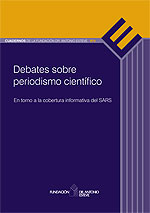
Nº 4. Debates sobre periodismo científico. En torno a la cobertura informativa del SARS
In 2003, information on Severe Acute Respiratory Syndrome (SARS) was widely diffused in the media. The alarm spread on a possible global pandemic worldwide, particularly since the World Health Organization (WHO) made the unprecedented decision to warn against traveling to Western cities like Toronto. At that moment, SARS changed from being an isolated fact in a Chinese region to becoming a global event, only surpassed by the beginning of the war against Iraq. That is why the multilevel crisis brought on by ‘atypical pneumonia’ is a perfect example for the analysis of the information issued in the media and therefore an ideal topic for the second debate on science journalism of the Esteve Foundation. Four scientists involved in the field of infectious diseases on one side and four science journalists on the other sat around the same table last May 26 to analyze media coverage of SARS put into perspective.
Many aspects were mooted in the debate. The role and (sometimes disputable) management of the WHO, the informative secretiveness of the Chinese institutions, the problems concerning timing and urgency in journalism, the friction between the informative function and the training function of the media, the level of specialization of the professionals that handle scientific information. These are just a small example of the topics raised, all to be gathered in the next Esteve Foundation Booklet.
The participants in this second meeting between journalists and scientists were the following: on the one hand, Pere Gaviria, Assistant Head of the Society Section of the information services of Televisió de Catalunya, Pablo Jáuregui, Head of the Science Section of the newspaper El Mundo, Pilar Perla, Coordinator of the Supplement Tercer Milenio of the newspaperHeraldo de Aragón, and Gemma Revuelta, Assistant Director of the Observatorio de la Comunicación Científica of the Universitat Pompeu Fabra of Barcelona; on the other hand, in the scope of infectious diseases, José María Aguado, from the University Hospital 12 de Octubre of Madrid, Francesc Gudiol, from the University Hospital of Bellvitge of Barcelona, Ildefonso Hernández, from the Public Health Department of the University of Alicante, and Jerónimo Pachón, from the University Hospitals Virgen del Rocío of Seville.
*Only available in print format while supplies last.