Arxius

Núm. 20 (2022)
Triangle volume 20 includes four articles. The first two papers are located in the field of literary studies and deal with three women authors: Teresa Wilms Montt, Alejandra Pizarnik and María Zambrano. The third paper presents an interdisciplinary work in which linguistics and literature collaborate in the arduous task of literary translation. The last paper deals with the study of the Egyptian language from Plato's philosophical naturalism and Ockham's nominalism.

Núm. 19 (2021)
The four papers included in this volume use computational tools to perform linguistic or literary analysis. Two of the works use computational stylistics techniques to analyze the work of two Moroccan poetesses. The other two articles have in common that they focus on Chinese and its relationship with the Spanish language: one of the articles is framed in the field of literary translation and the other one presents a work on phonetics in the field of second language acquisition.

Núm. 18 (2020)
This volume includes five papers that are a good example of the interdisciplinarity promoted by this journal. The origin of language, the poet Justo Alejo, semantic change, the active participle of Spanish or the life of Santa María Egipciaca are some of the topics covered in the articles included in this volume.

Núm. 17 (2019)
This volume includes five papers that offer a sample of how women contribute to the history of literature with their “feminine writing of everyday life”.

Núm. 16 (2018)
This volume includes three papers. The first paper analyzes the sociolinguistics adequacy in advertisements. The second paper focuses on the analysis of the linguistic differences between TV and YouTube subtitling. The third paper presents the theoretical bases for the definition of a grammar that accounts for different levels of grammaticality.

Núm. 15 (2017)
This volume includes two papers dealing with communication on social networks. The first paper compares the traditional genderlect characterization with linguistic gender traits in social networks and provides a genderlect characterization for this new type of communication. The second paper applies the Milroy and Milroy (1987) Social Networks model to the linguistic analysis of interactions on Facebook and Twitter and shows that those two networks provide different types of reticulated structures.

Núm. 14 (2016)
This volume includes two works. The first one presents a methodology for inducing the grammar of Yorùbá from the grammar of English by using a constraint solving model, the Womb Grammars. The second paper focuses on the study of linguistic violence and, from a corpus of interactions extracted from Twitter and Facebook, analyzes the degrees of violence in speech acts and the resources and techniques used to produce violent speech acts

Núm. 13 (2015)
This volume includes two works. The first one presents a study on the situation of the Spanish language in the USA, considering basic concepts in sociolinguistics such as identity, attitude and prestige. The second paper analyzes from a linguistic point of view the interactions on WhatsApp in order to characterize the language used, the management of non-verbal communication and the conversational nature of this type of interactions.

Núm. 12 (2014)
Starting from a corpus study, this work presents a characterization of the loanwords from a sociolinguistic perspective. The phenomenon of lexical variation caused by the incorporation of loanwords is addressed. An overview of the main contributions to the concept of loanword made by various authors is provided.

Núm. 11 (2013)
This volume presents six studies related to the novel Deseos published by Marina Mayoral in 2011. The first article is by Marina Mayoral, who explains how she has conceived the construction of Deseos. The remaining five papers analyze the title, the space, the time, and the protagonist of the novel.

Núm. 10 (2012)
In order to analyze the Internet presence of Spanish theater companies, the different ways in which the theater appears on the Internet are studied. Twenty companies of Spanish theater with very different idiosyncrasies that reflect the current Spanish theater scene are examined.

Núm. 9 (2012)
This study reflects on learning Chinese culture and the knowledge that Chinese students hold about Western culture and it provides a methodology for conducting a course on the History of Spanish Literature adressed to Chinese students, offering a teaching unit as a sample.

Núm. 8 (2012)
This volume contains a collection of articles that present mathematical approaches to languages. The included works were discussed at the weekly seminars organized by the GRLMC.
Linguistics, computer science and formal languages have had a mutual influence over the years. Following this tradition of interaction, the articles in this issue provide multidisciplinary approaches which can improve the processing of natural and artificial languages

Núm. 7 (2012)
This volume aims to provide a state-ofthe- art of the work recently done, by some relevant Spanish Research Groups, in the area of nets of processors.
It could be interesting for a wide spectrum of audience: from mathematicians and linguists to computer scientists that are looking for efficient new models of computation to apply to their problems.
Núm. 6 (2011)
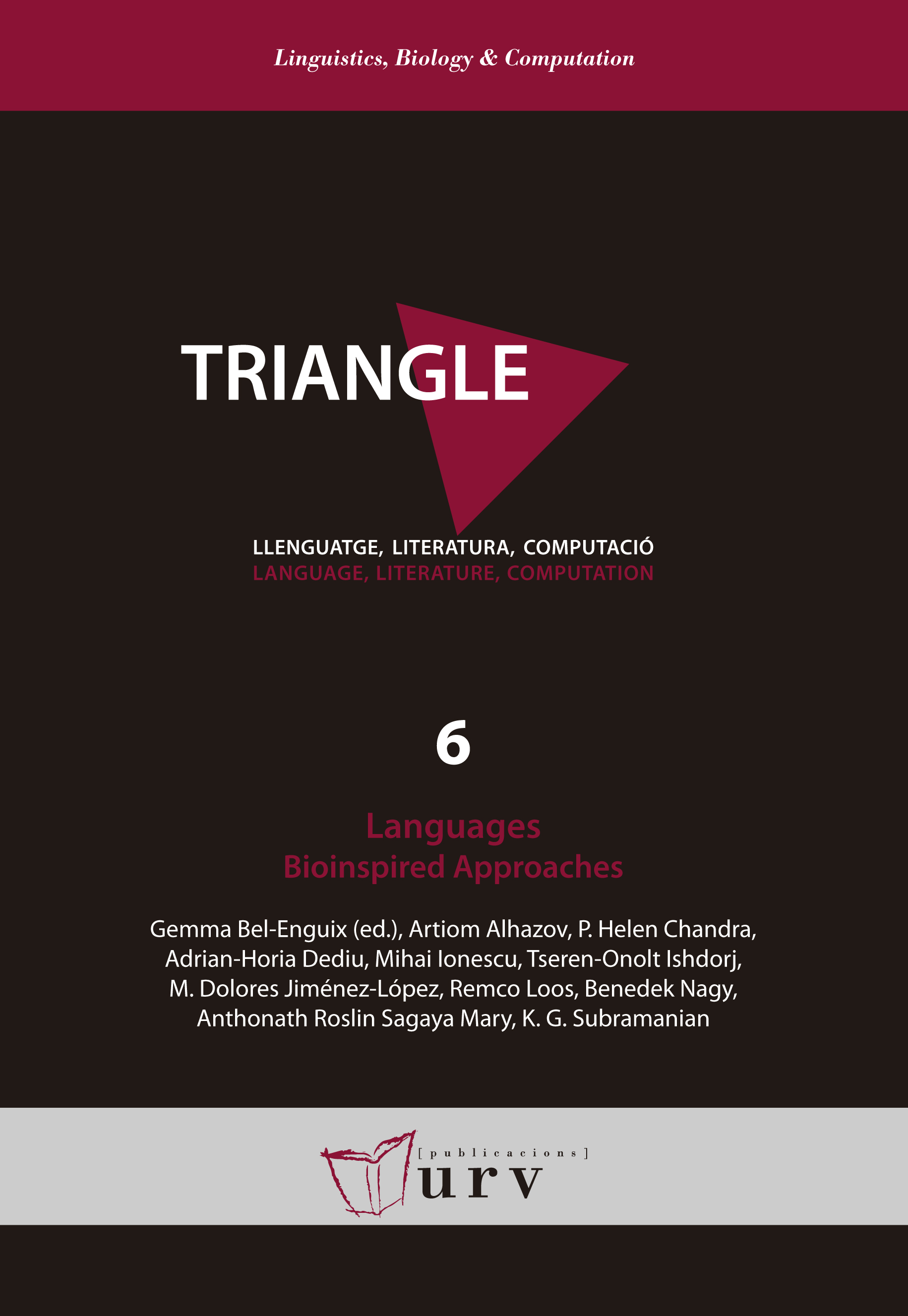
This volume includes several articles in the area of bioinspired approaches to formal language theory that were presented and discussed in the GRLMC weekly seminars.
Following the tradition of interaction between biology, language and computer science, the contributions provide new ideas, tools and formalisms for the description, analysis and processing of natural and artificial languages.

Núm. 5 (2011)
Este volumen pretende ser un instrumento o herramienta útil para los profesores que dan clase de español a alumnos extranjeros de enseñanza universitaria y para los propios alumnos extranjeros que, habiendo superado su primer año de aprendizaje, empiezan a profundizar en nuestro idioma.

Núm. 4 (2011)
El volumen reúne trabajos en torno a temas relacionados con la mujer de seis profesoras de la Universitat Rovira i Virgili. Desde la historia, la educación, el periodismo y el teatro, los cuatro artículos presentados desentrañan el trato de lo femenino en diversas áreas de la cultura. El objetivo es preservar la memoria de aquellas mujeres cuyo trabajo no ha sido suficientemente reconocido, rescatándolas así del olvido.

Núm. 3 (2010)
La escritora argentina Alejandra Pizarnik inicia desde la adolescencia un viaje poético que la lleva a construir su propia realidad a través de la palabra, camino que culminará con su personal descenso a los infiernos desde un jardín supuestamente edénico.
Este estudio intenta descifrar las claves de la poesía pizarnikiana, capaz de ahondar en los sentimientos más oscuros de la vida a través de un lenguaje simbólico difícil pero fecundo.

Núm. 2 (2010)
Programación Lógica is the second issue of the journal TRIANGLE, released in December 2010. It has been published under the TRIANGLE series Linguistics, Biology Programación Lógica is an introduction to Logic Programming in Sp & Computation.
This issue has been contributed by Veronica Dahl (Simon Fraser, Canada & Tarragona) and Alejandro Javier García (Universidad Nacional del Sur, Argentina).
Programación Lógica is an introduction to Logic Programming in Spanish, addressed to non-specialists. The text intends to combine scientific rigor and clarity. It is a very convenient starting point to the LP paradigm for humanities students.
The issue has been supported by the Departament de Filologies Romàniques (URV), the project Language, Automata and Formal Languages (MTM2007-63422) and the project DEDICON: Desarrolllo para Dispositivos de Computación Natural (CCG08-UAM/TIC 4425).

Núm. 1 (2010)
Introduction to Language and Computation is the first issue of the journal TRIANGLE, released in September 2010. It has been published under the TRIANGLE series Linguistics, Biology & Computation.
It collects some of the courses given in a workshop addressed to students of humanities and hold at URV during the academic year 2009-2010. This report aims to give a comprehensive view on how computation can help in the processing and understanding of natural language.
The issue has three contributions:
Leonor Becerra-Bonache, Introduction to Grammatical Inference for Linguists, 1-29
Henning Christiansen, Logic Programming for Linguistics: a short introduction to Prolog, and Logic Grammars with cosntraints as an easy way to Syntax and Semantics, 31-64
Veronica Dahl, An Introduction to Natural Language Processing: the Main Problems, 65-78
The issue has been supported by the Departament de Filologies Romàniques (URV), the project Language, Automata and Formal Languages (MTM2007-63422) and the project DEDICON: Desarrolllo para Dispositivos de Computación Natural (CCG08-UAM/TIC 4425).